
Home
>
Recruitment
>
Beyond the Lowest Bid: How to Evaluate a Technology Partner for a Critical Project

Beyond the Lowest Bid: How to Evaluate a Technology Partner for a Critical Project

Written by:
Ravinder Kulsari
Beyond the Lowest Bid: How to Evaluate a Technology Partner for a Critical Project
Build a more confident shortlist with WorkWall. Explore technology firms and resources, then assess every proposal against the same criteria.
Explore the WorkWall marketplace
Updated:
November 19, 2026
Choosing a technology partner is often presented as a price comparison. But two bids can differ in scope, assumptions, team seniority, testing, support, and risk. If those differences are not made explicit, a low initial quote may simply move cost or uncertainty into a later phase. A practical scorecard does not remove judgment. It makes judgment visible. By agreeing on the questions and pass/fail requirements before reviewing proposals, a team can explain why a provider fits—and what still need
Start with requirements that are non-negotiable

Before scoring, define the conditions a provider must meet to be considered. Depending on the project, these may include a required technical capability, availability during a specific window, security or confidentiality controls, a delivery location, or acceptance of a particular contract process.

Find the right technology partner with WorkWall

Explore the WorkWall marketplace, share your requirements, and use your evaluation criteria to compare potential technology firms and resources.
Set non-negotiable requirements first
Score every proposal on the same eight criteria
Meet the team that will actually deliver
Compare total cost, not just the headline price
Explore the WorkWall talent marketplace

Treat these as gates, not bonus points. A proposal that misses a critical requirement should not rise to the top because it is inexpensive or especially polished. Ask your security, legal, procurement, and technical stakeholders to review requirements that fall within their remit.

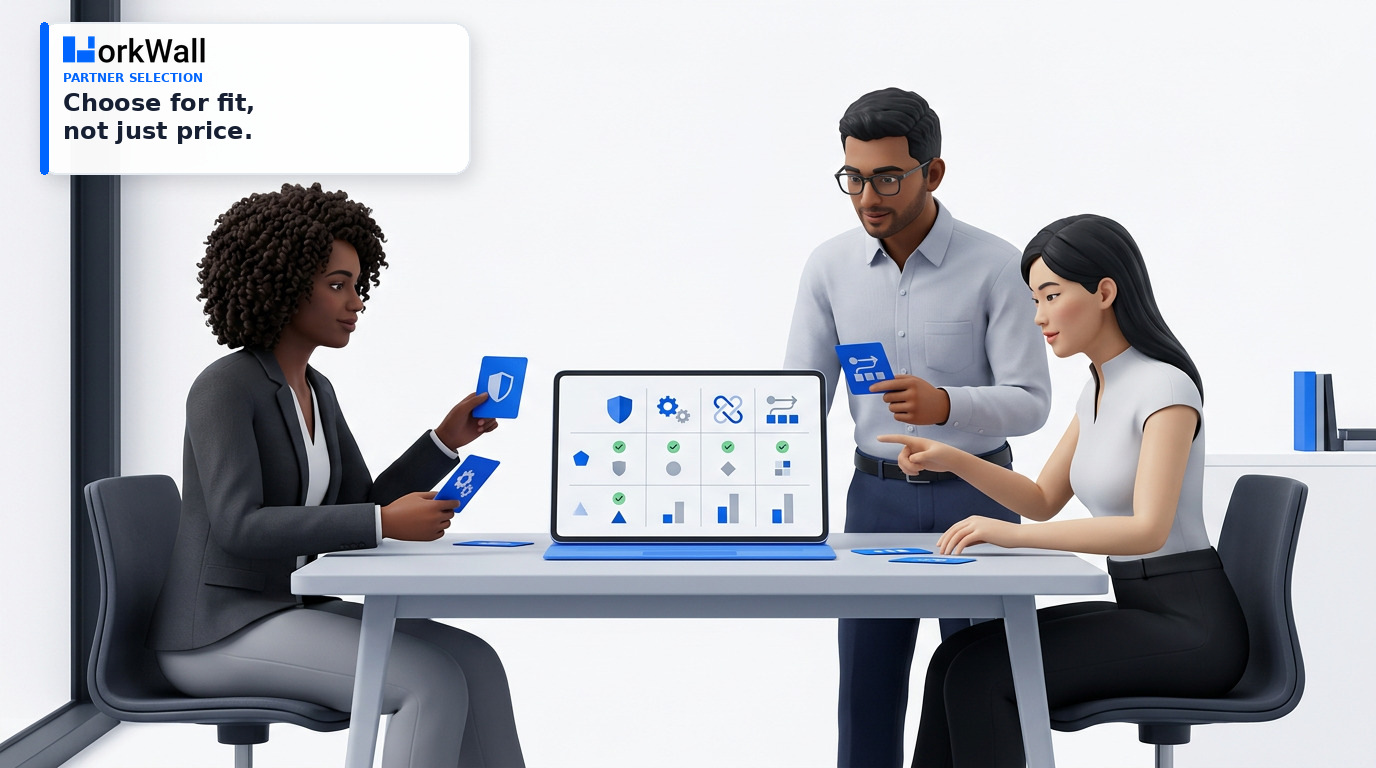
An eight-part technology partner scorecard

Rate each criterion on a simple scale—for example, 1 = weak evidence, 3 = adequate, 5 = strong and specific evidence. Add a short note explaining the score. If some criteria matter more for this project, agree on their relative importance before reviewing proposals; do not change the rules after seeing a preferred bid.

1. Understanding of the business outcome

Does the proposal address the reason for the project, or only repeat the feature list? Look for a clear explanation of the problem, the intended users, and how the provider would confirm that the work is delivering value.

2. Relevant experience and evidence

Ask for examples that resemble your project in technology, operating context, or complexity. A logo list is not enough. Useful evidence explains what the team did, what constraints it faced, and what the prospective partner learned. Confirm references where appropriate and with permission.

3. The proposed team and availability

Evaluate the people who would actually do the work—not only the senior person who presents the proposal. Check relevant skills, roles, availability, continuity, and how substitutions would be handled. A strong firm-level profile does not automatically mean the named team is the right fit.

4. Delivery plan, milestones, and quality

Look for a sequence that makes sense: discovery, design or planning, implementation, testing, review, and handover where relevant. Are dependencies visible? Are milestones tied to outputs and acceptance? Does the plan explain how issues will be surfaced and resolved?

5. Security, privacy, intellectual property, and compliance

The provider should be able to explain how it will work within the controls that apply to your project. Consider data access, account management, confidentiality, ownership of deliverables, subcontracting, and any regulatory or contractual requirements. Have the right internal specialists validate the details; a proposal is not a substitute for legal or security review.

6. Fit with your technology environment

Assess how the proposed approach works with your current architecture, integrations, data, and operational constraints. Ask what the provider would preserve, replace, or connect—and what assumptions need a technical discovery session. Favor maintainable solutions over unexplained complexity.

7. Communication, ownership, and knowledge transfer

Who is accountable day to day? How will decisions, risks, changes, and approvals be recorded? What documentation, training, or handover will your team need at the end? Clear ownership is especially important when several vendors or internal groups share delivery.

8. Commercial clarity and total cost

Compare the same scope, not just the headline price. Review assumptions, exclusions, rate or milestone structure, change handling, support, expenses, and payment triggers. Ask each provider to identify the conditions that could change the estimate. A transparent proposal may be easier to manage even if its initial figure is not the lowest.

A simple review workflow

  1. Agree the outcome and gates. Decide what must be true for a proposal to qualify.
  2. Use one brief and one question set. Give every provider the same baseline information.
  3. Score independently. Ask evaluators to record evidence before the group discussion.
  4. Compare differences. Discuss why reviewers scored a criterion differently, not just the final total.
  5. Meet the delivery team. Confirm that the people, availability, and communication style match the proposal.
  6. Validate references and assumptions. Resolve material unknowns before selection.
  7. Document the decision. Record why the provider was selected, what risks remain, and who owns the next step.

Red flags worth investigating

  • The proposal promises outcomes without describing assumptions or dependencies.
  • The named team is missing, unavailable, or different from the people in the sales discussion.
  • Scope exclusions, change fees, or handover responsibilities are hard to find.
  • Security or data questions are answered with broad assurances instead of a reviewable process.
  • The provider resists explaining how it will measure progress or manage problems.

A red flag is a prompt to ask a better question, not always a reason to reject a provider. Give the team a chance to clarify—and keep the answer in the evaluation record.

How WorkWall fits into partner discovery

WorkWall is a marketplace for businesses, technology firms, and technology resources. It can be one channel for discovering potential partners and reviewing proposals. Use the same brief and scorecard for each option, and complete your normal commercial, technical, security, and legal checks before work begins.

‍

Find the right technology partner with WorkWall

Explore the WorkWall marketplace, share your requirements, and use your evaluation criteria to compare potential technology firms and resources.
Set non-negotiable requirements first
Score every proposal on the same eight criteria
Meet the team that will actually deliver
Compare total cost, not just the headline price
Explore the WorkWall talent marketplace

Related articles

Browse all articles

Revolutionizing Customer Experiences with AI-driven Salesforce CRM

How we can help you

Revolutionizing Healthcare with AWS IoT for Enhanced Patient Monitoring

How we can help you

Transforming Supply Chain Management with Oracle Cloud Applications

How we can help you

Revolutionizing Customer Service with ServiceNow AI: A Strategic Overview

How we can help you

Revolutionizing Customer Experiences with AI-Driven Dynamics 365 Insights

How we can help you

Revolutionizing Customer Experiences with ServiceNow’s AI-Powered Solutions

How we can help you

Transforming Customer Service with ServiceNow’s AI-Powered Solutions

How we can help you

Transforming Customer Service with ServiceNow's Next-Gen AI Capabilities

How we can help you

Navigating Compliance in Cloud Architecture with AWS

How we can help you

Subcribe to our weekly email newsletter

Stay ahead of the tech curve! Subscribe to our weekly newsletter for a curated dose of the latest industry insights, project highlights, and exclusive updates.

Thanks for subscribing to our newsletter
Oops! Something went wrong while submitting the form.