


.png)
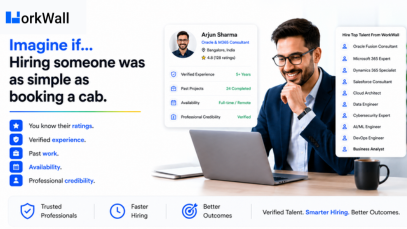
Imagine you're evaluating two consultants for a critical Oracle implementation. Both have impressive resumes and claim relevant experience. However, one can demonstrate verified certifications, completed projects, client recommendations, and measurable outcomes, while the other relies primarily on self-reported credentials. Most business leaders already know which professional they would trust. This reflects a larger shift taking place across modern hiring. Organizations are increasingly prioritizing evidence over claims, outcomes over promises, and verified expertise over assumptions. Whether hiring a consultant, contractor, or specialist, businesses want confidence that the person they engage can deliver meaningful results.

Last month, a hiring manager shared a frustration that many business leaders can relate to:
"I can book a cab, order groceries, schedule a meeting, and transfer money in minutes. But finding the right consultant for a critical project still takes weeks."
It's a fair observation.
Technology has transformed almost every aspect of how we work and make decisions. We expect real-time visibility, instant access, transparent reviews, and seamless user experiences. Whether we're choosing a hotel, a software vendor, or even a restaurant, we have the information we need to make confident decisions quickly.
Yet hiring remains one of the few business processes that often feels stuck in a different era.
Organizations still spend weeks reviewing resumes, validating credentials, scheduling interviews, and assessing whether a candidate or contractor truly has the expertise they claim. The challenge becomes even more pronounced when businesses need highly specialized professionals such as Oracle consultants, Microsoft 365 experts, Dynamics 365 specialists, Salesforce architects, or cybersecurity practitioners.
The irony is that talent isn't necessarily scarce.
In fact, the global workforce has never been more connected, skilled, and accessible.
The real challenge is discovering the right expertise at the right time—with enough confidence to make a decision.
This raises an important question:
If technology has simplified nearly every other transaction, why is hiring trusted expertise still so complicated?
As businesses increasingly adopt skills-based hiring, project-driven teams, and independent talent models, the answer may lie in rethinking how we discover, evaluate, and engage professionals in the first place.
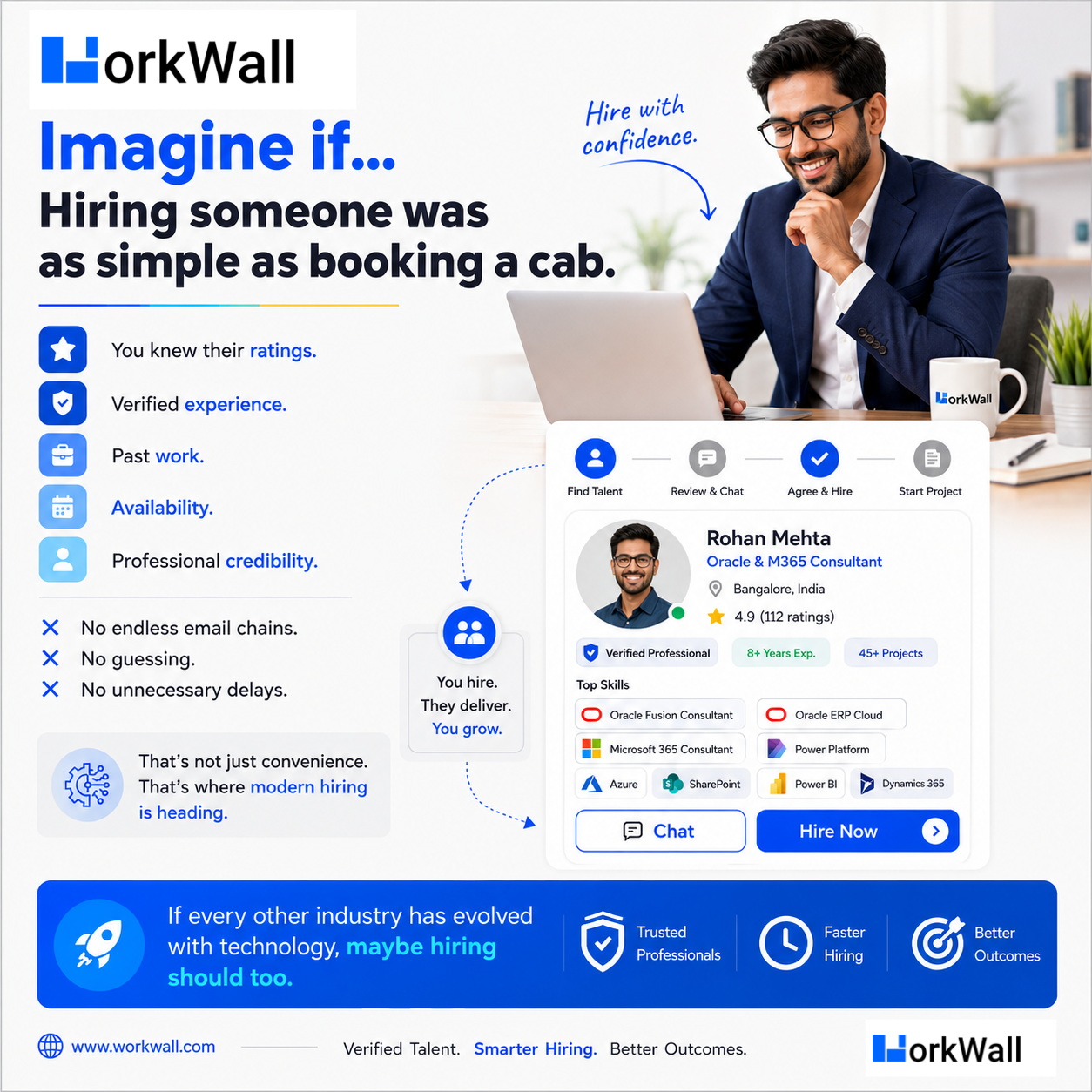
Think about the last time you booked a cab. Within minutes, you knew who was arriving, their rating, how many trips they had completed, and exactly when they would reach you. The entire experience was built around one thing: confidence.
You didn't have to send emails, verify credentials, or wonder whether the driver was qualified. The information was already available, helping you make a decision almost instantly.
Now compare that experience to hiring a specialist for a critical business project.
Whether you're looking for an Oracle consultant, a Microsoft 365 expert, a Dynamics 365 specialist, or a cybersecurity professional, the process is often far more complicated. Businesses post requirements, review resumes, schedule interviews, check references, and coordinate with multiple stakeholders. Weeks can pass before a decision is made—and even then, uncertainty remains.
The reality is that hiring hasn't evolved at the same pace as the rest of the digital world. While organizations have embraced cloud technology, automation, AI, and real-time analytics, hiring decisions are still heavily dependent on fragmented information and manual validation processes.
This isn't because talent is unavailable. In fact, skilled professionals are more accessible today than ever before. The modern workforce includes independent consultants, project-based specialists, remote professionals, and global experts who can contribute to organizations regardless of location.
The real challenge is visibility.
Organizations often struggle to answer critical questions before making a hiring decision:
Without clear answers, hiring becomes slower, riskier, and more expensive than it needs to be. And in an environment where business priorities shift rapidly, delays in finding the right expertise can directly impact project timelines, innovation initiatives, and growth opportunities.
That's why forward-thinking organizations are beginning to rethink how they discover and engage talent. The focus is no longer on collecting more resumes—it's on identifying trusted expertise faster.
For decades, resumes have been the foundation of hiring decisions.
They tell us where someone worked, what role they held, and how long they spent there. While that information is useful, it doesn't always answer the questions that matter most to businesses today.
Can this person solve the problem we're facing?
Have they delivered similar outcomes before?
Can they contribute from day one?
As projects become more specialized and technology evolves faster than ever, organizations are increasingly prioritizing evidence over assumptions. Hiring managers want more than a list of responsibilities—they want proof of execution.
Think about how businesses evaluate software today. They don't simply read the product description and make a purchase. They look for reviews, case studies, customer testimonials, ratings, and real-world results.
The same shift is happening in hiring.
Companies are becoming more interested in what professionals have accomplished rather than simply where they have worked. Project outcomes, certifications, client feedback, implementation experience, and demonstrated expertise are becoming stronger indicators of success than traditional credentials alone.
This is particularly important when hiring specialized talent.
If a company is looking for an Oracle Fusion consultant, for example, the hiring decision isn't based solely on whether the candidate has Oracle listed on their resume. What matters is whether they have successfully completed ERP implementations, managed integrations, solved business challenges, and delivered measurable results.
The same principle applies to Microsoft 365 consultants, Dynamics 365 specialists, Salesforce experts, cybersecurity professionals, and cloud architects.
Businesses aren't hiring for job titles.
They're hiring for outcomes.
That's why organizations are increasingly moving toward skills-based hiring models, where demonstrated capability carries more weight than traditional indicators. Instead of asking, "Where have you worked?" the more important question becomes, "What have you built, delivered, or improved?"
The professionals who can clearly demonstrate their expertise gain a competitive advantage. Likewise, businesses that can identify and validate that expertise quickly are able to make faster, more confident hiring decisions.
In a world where speed and specialization matter, proof is becoming the new resume.
Not long ago, building a team meant hiring full-time employees.
If a business needed a new skill set, the typical approach was straightforward: create a job description, post it on multiple platforms, conduct interviews, negotiate an offer, and onboard a new employee.
While this model still has its place, the nature of work has changed dramatically.
Today's businesses operate in an environment where priorities shift quickly, technology evolves constantly, and projects often require highly specialized expertise for a limited period. Hiring a full-time employee for every requirement is no longer the most practical—or efficient—solution.
Consider a company implementing Oracle Fusion Cloud, migrating to Microsoft 365, integrating Salesforce with existing systems, or deploying a new AI-driven solution. These projects often require niche expertise that may only be needed for a few months.
In such cases, businesses aren't looking to fill a permanent position. They're looking to solve a specific problem.
This shift has given rise to what many call the on-demand workforce—a growing network of independent consultants, contractors, specialists, and project-based professionals who bring expertise exactly when it's needed.
For organizations, the benefits are clear:
At the same time, professionals are embracing this model as well. Experienced consultants and independent experts increasingly prefer project-based engagements that allow them to work across industries, build diverse portfolios, and focus on delivering measurable outcomes.
The result is a workforce that is more agile than ever before.
However, this flexibility introduces a new challenge.
When talent is distributed across different locations, platforms, and networks, businesses need a reliable way to identify the right experts, assess their credibility, and engage them quickly.
In other words, access alone isn't enough.
Trust becomes the deciding factor.
A hiring manager doesn't just want to know that an Oracle consultant is available. They want confidence that the consultant has successfully delivered similar implementations. They want visibility into previous projects, relevant certifications, client feedback, and professional reputation.
As the workforce becomes increasingly decentralized, trust and transparency are becoming the foundations of modern hiring.
And that's exactly why traditional hiring methods are starting to fall short.
The next evolution isn't simply about finding talent.
It's about finding verified expertise.
Imagine you're evaluating two consultants for a critical technology project. Both have impressive resumes, relevant experience, and strong communication skills. However, one can demonstrate successful project outcomes, verified certifications, client recommendations, and a proven track record of delivering similar implementations. The other simply claims to have worked on comparable projects.
Most business leaders already know which candidate they would trust more.
This reflects a larger shift taking place across the hiring landscape. Organizations are no longer making decisions based solely on claims and credentials. They increasingly want evidence that a professional can deliver results. Whether selecting software, evaluating vendors, or engaging talent, decision-makers expect transparency before making commitments.
We've already seen this behavior become standard in other industries. Before booking a hotel, people read reviews. Before purchasing software, they explore customer stories and product ratings. Before choosing a service provider, they compare experiences from previous customers. Hiring is beginning to follow the same pattern.
As businesses become more project-driven and specialized expertise becomes more valuable, trust is becoming a critical factor in hiring decisions. Organizations want visibility into project experience, certifications, industry expertise, client feedback, and measurable outcomes. The goal is no longer to identify candidates who look qualified on paper; it's to identify professionals who have already demonstrated success in similar situations.
This is especially important when engaging independent consultants and project-based specialists. Unlike traditional hiring processes that may stretch across several months, businesses often need these professionals to contribute quickly. The faster organizations can validate expertise, the faster they can move projects forward and reduce operational delays.
Ultimately, trust reduces uncertainty. When businesses can confidently assess a professional's capabilities, hiring becomes faster, more efficient, and less risky. That's one of the key reasons why modern talent marketplaces are gaining traction—they help create the transparency and credibility that traditional hiring processes often struggle to provide.
For decades, hiring has revolved around a familiar process. Companies create job descriptions, post openings, collect applications, and then spend weeks filtering through candidates in the hope of finding the right fit. While this approach worked in a world dominated by traditional employment models, today's workforce operates very differently.
Businesses no longer hire only for positions—they hire for projects, outcomes, and specialized expertise. A company implementing Oracle Fusion Cloud may need a consultant for six months. Another organization migrating to Microsoft 365 may require a specialist for a specific transformation initiative. A startup building an AI-powered product might need a machine learning expert without wanting to commit to a full-time hire.
In each of these scenarios, the goal isn't to attract hundreds of applicants. The goal is to quickly identify the right expert who can solve a specific business challenge.
This shift is changing the role of hiring platforms. Traditional job boards were designed to maximize applications. Modern talent marketplaces are designed to maximize relevance. Instead of asking businesses to sort through large volumes of candidates, they focus on helping organizations discover professionals based on skills, expertise, availability, project experience, and credibility.
The difference may seem subtle, but its impact is significant. Rather than measuring success by the number of resumes received, businesses are beginning to measure success by how quickly they can engage the right expertise and start delivering results.
For professionals, this evolution creates opportunities as well. Independent consultants, contractors, and specialists are no longer limited to local networks or traditional recruitment channels. Their expertise can be discovered by organizations across industries and geographies, creating a more dynamic and accessible workforce ecosystem.
As skills become more specialized and business requirements become more project-driven, talent marketplaces are emerging as a natural evolution of hiring. They provide the visibility, flexibility, and trust that modern organizations need while giving professionals greater control over how they engage with opportunities.
The question is no longer whether businesses should embrace this model. The question is how quickly they can adapt to it.
In today's business environment, opportunities rarely wait. Product launches, digital transformation initiatives, cloud migrations, compliance projects, and technology implementations all operate on tight timelines. When organizations cannot access the right expertise quickly, delays often ripple across the entire business.
A delayed ERP implementation can impact operations. A postponed Microsoft 365 rollout can slow workplace transformation efforts. A shortage of specialized talent can push back product development and innovation initiatives. In many cases, the cost of waiting far exceeds the cost of hiring.
This is why hiring is increasingly becoming a business agility challenge rather than a recruitment challenge.
Organizations that can identify and engage trusted professionals quickly gain a significant advantage. They can respond faster to market changes, execute projects more efficiently, and access specialized knowledge exactly when it is needed. Instead of spending weeks searching for expertise, they can focus on solving business problems and creating value.
The most successful companies understand that talent is no longer just a resource—it is a strategic enabler. Access to the right expertise at the right time can accelerate growth, improve execution, and help organizations remain competitive in rapidly changing markets.
As hiring continues to evolve, speed and trust will become increasingly interconnected. Businesses will not only need access to talent; they will need confidence that the talent they engage can deliver results from day one.
And that's exactly why the future of hiring is moving toward a model built on visibility, credibility, and on-demand expertise rather than resumes alone.
It sounds like an unusual comparison at first.
After all, booking a cab and hiring an Oracle consultant are completely different decisions. One takes a few minutes. The other can influence the success of a business-critical project.
But the comparison isn't really about the service itself.
It's about the experience.
When you book a cab, you already have the information needed to make a confident decision. You can see ratings, reviews, availability, estimated arrival times, and a history of completed trips. The platform removes uncertainty and helps you choose quickly.
Now consider how businesses hire specialized talent.
Organizations often spend days—or even weeks—trying to answer basic questions. Does this professional have the required expertise? Have they worked on similar projects? Are they available when needed? Can their experience be verified? Will they be able to deliver the expected outcomes?
The more time spent searching for answers, the longer projects remain on hold.
What businesses really need isn't a faster application process. They need faster access to trusted expertise.
Imagine a hiring experience where decision-makers can instantly view a consultant's project history, certifications, domain expertise, availability, and professional credibility. Imagine reducing weeks of manual verification into a transparent and informed evaluation process.
That's not about making hiring casual.
It's about making hiring smarter.
As workforce models continue to evolve, businesses are increasingly looking for ways to reduce friction without compromising quality. The organizations that succeed won't necessarily be the ones with the largest recruitment teams or the biggest applicant pools. They'll be the ones that can identify the right expertise faster, engage talent confidently, and move projects forward without unnecessary delays.
The future of hiring isn't about eliminating human judgment. It's about giving decision-makers better information so they can make better decisions.
And that's where technology is creating a meaningful shift.
The way businesses access talent is changing.
Organizations are becoming more project-driven, more global, and more dependent on specialized skills. At the same time, professionals are embracing flexible work models that allow them to contribute their expertise across multiple organizations and industries.
This shift is creating a workforce that looks very different from the one most businesses were designed around.
Instead of relying solely on traditional hiring cycles, companies are building ecosystems of full-time employees, consultants, contractors, specialists, and project-based experts. Success increasingly depends on how effectively organizations can access and manage this broader talent network.
The challenge is no longer finding people.
The challenge is finding the right people at the right time.
Businesses need visibility into expertise. Professionals need opportunities that align with their skills. And both sides need a foundation of trust that enables them to work together confidently.
That's why the future of hiring is moving beyond resumes and job boards. It's becoming more transparent, more skills-focused, and more outcome-driven.
In many ways, the most successful hiring experiences of the future will feel less like recruitment and more like discovery—helping businesses connect with proven expertise exactly when it's needed.
Because in a world where technology has simplified almost every other business process, hiring shouldn't be the exception.
It should be just as transparent, accessible, and efficient as the modern experiences we've already come to expect.
For years, businesses have accepted slow hiring processes as an unavoidable reality. Long recruitment cycles, manual verification, and limited visibility into expertise have simply been part of the process.
But the nature of work has changed.
Organizations today operate in fast-moving environments where access to specialized knowledge can determine the success of a project, a transformation initiative, or even an entire business strategy. Waiting weeks to identify the right expertise is becoming increasingly difficult to justify.
The good news is that the solution isn't necessarily finding more talent.
It's creating better ways to discover, evaluate, and engage the talent that already exists.
As hiring continues to evolve, businesses will place greater value on verified expertise, proven outcomes, professional credibility, and real-time visibility. The organizations that embrace this shift will be better positioned to adapt, innovate, and compete in an increasingly dynamic marketplace.
And perhaps that's the real lesson.
The future of hiring isn't about making talent easier to find.
It's about making expertise easier to trust.


Stay ahead of the tech curve! Subscribe to our weekly newsletter for a curated dose of the latest industry insights, project highlights, and exclusive updates.